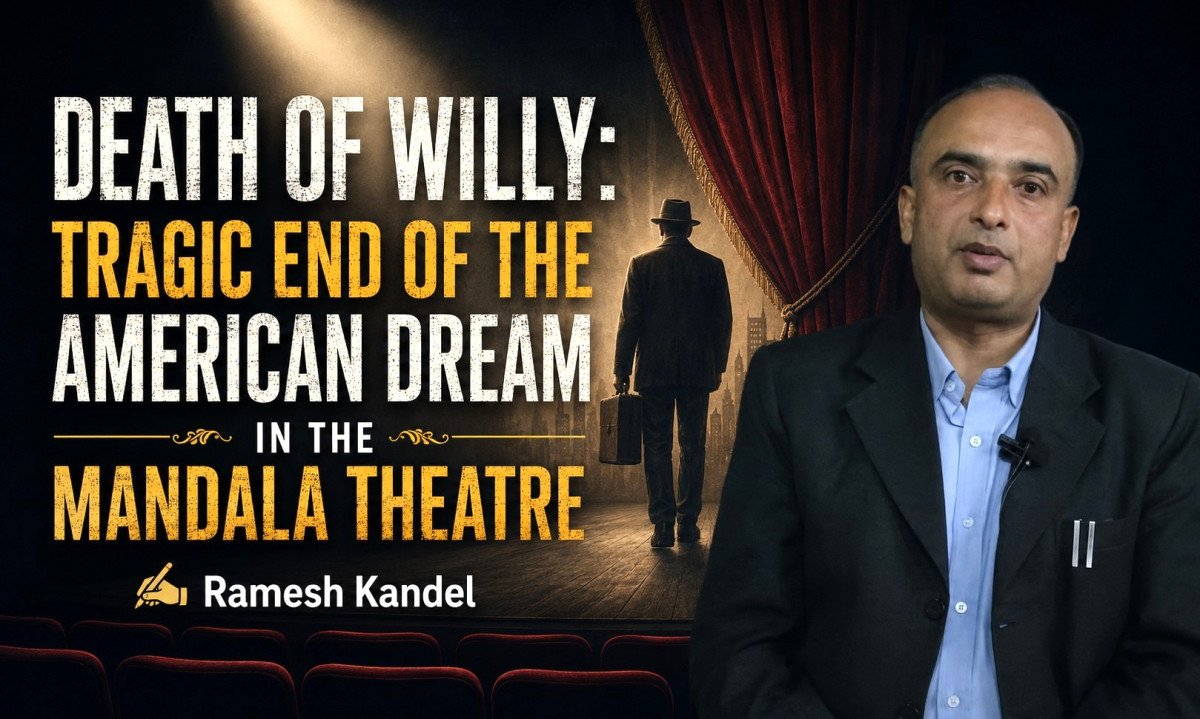
Ramesh Kandel
M.ED. EPM (TU)
M.ED. English (KU)
Mandala Theatre inspired me to write about working class people like me as a teacher in the society. I tried to explore the effect of the American dream in the life of working-class people like Willy Loman through the Marxist perspective and how disaster occurs at a later age of life, how the workers are exploited and forced to leave their job there and become the victim of the financial crisis. The extramarital relationship also plays a role in the tragedy as Willy spent most of his youth with that woman resulting in his uncertain future.
Miller's 'Death of a Salesman' is the primary source. I also explore the research articles related to the tragic end of Willy Loman in the play Death of a Salesman. I have tried to analyze the various of events in Willy’s life from the Marxist Critical theory. Karl Marx catalogues two social classes: one exploiting, which is the productive class, and the other exploiting, which is the non-productive class. On the same ground as exploiting the attitude of the capitalist, the workers in the ranch are exploited. Of course, many Marxist insights into human behavior involve the damaging effects of capitalism on human psychology, and those damaging effects often appear in our relationship to the commodity. (Tyson, 2006, p.62), Marx considered literature, like all cultures, as a reflection of society and the political and socio-economic conditions. The study of culture thus gives information about society as a whole, and in literature, both style and content are interesting aspects to analyze. (Carolin, Helena, 2009)
WILLY LOMAN FROM THE MARXIST PERSPECTIVE
Willy Loman is the central character in Arthur Miller's play "Death of a Salesman." He is a sixty-three-year-old travelling salesman who has spent his life working for a company called Wagner Company. Willy is a tragic figure, struggling with the American Dream and grappling with his own perceived failures and delusions. Willy is portrayed as a weary and disillusioned man, struggling to make ends meet and constantly feeling overshadowed by his more successful colleagues and his older brother, Ben. Throughout the play, Willy's mental state deteriorates as he experiences frequent hallucinations and memories of the past, blurring the line between reality and fantasy. In his younger years, Willy had high hopes for success and wealth. He believed that charisma and personal relationships were key to achieving the American Dream. However, as he grows older, Willy's confidence wanes, and he becomes increasingly bitter and resentful. He feels trapped in a cycle of mediocrity and is unable to achieve the success and recognition he desires.
Willy's relationship with his family is strained, particularly with his oldest son, Biff. He holds high expectations for Biff, envisioning him as a successful businessman. However, when Biff fails to live up to these expectations, it becomes a source of great disappointment and conflict between them. Throughout the play, Willy experiences moments of despair and desperation. He contemplates suicide as a way to provide for his family through the life insurance money. Ultimately, he takes his own life in a car accident, hoping that his death will bring financial security and a sense of achievement to his family.
Willy Loman's character represents the tragic decline of the American Dream and the consequences of chasing material success at the expense of personal happiness and fulfilment. His struggles, failures and ultimately tragic end makes him a complex and memorable character in the play. Willy Loman represents the American dream in Miller's death as a salesman. He desired to labour hard and quench the thirst for happiness and prosperity in the family. He hopes success is achievable by working hard, but he was exploited due to the deep-rooted capitalist principle in the company. In this drama, from the Marxist criticism eyes, Willy is forced to kill himself because he failed to accomplish his desire due to the capitalist system. In this study, Marxist theory is closely studied and applied the theory in relation to the dream of Willy, which collapsed in his old age in which phase people desire to live happily after the good settlement in the family.
Marx voiced that the product is the means of life produced through labour, but when alienated from the product, the labour is transformed into a servant of his object and loses his/her purpose in life. In the capitalist system, the workers start to compete among themselves. This kind of competition can't help the workers to improve their status, but it helps the capitalists who generate this idea. The workers begin to treat each other as objects. Almost all the workers are being victims of capitalist ideas. The protagonists, who also represent the working class, are influenced by capitalist ideology to a degree where they are not able to comprehend the deceptiveness of the system. (Eagleton, 1994, 23) Every worker has human emotion and sweet dreams in their life, but most of the dreams are collapsed by the tremors of powerful capitalism. In capitalism, the workers are categorized at the bottom of the class hierarchy.
WORKERS INSIDE THE CAPITALIST FENCE
When watching as well as reading this drama, a kind of dream (American Dream) which always makes someone escape from reality and move to a new land and job to quench the thirst for a prosperous life, but most of the dreamers can't accomplish their desire due to the exploitation of the capitalist thought.
The capitalist mode of production, created by the dominant ideology of a market economy, is a mode of production where the entire process is privatized. The bourgeoisie rules capitalist society by owning the land, property and means of production, and in order for the proletariat to survive in society, they are forced to sell their labour power. (Marx & Engels,1998, chapters 2-4). A capitalist employer is only interested in maximizing return, which naturally results in the exploitation of the workers. Through long workdays, poor work conditions and low remunerations, the workers are forced to extreme conditions and consequently exploited and objectified. Living in a capitalist society that has domination on ideology, the workers are never able to grasp their dream. Unless the economic base is replaced by another, people like Willy Loman will be forced to live in a class society ruled by voracity and exploitation.
According to Mujahidah& Wardani (2021), the playwright, Arthur Miller, employs Willy Loman's character to symbolize the dysfunctional notion of the American Dream. Willy's pursuit of the American Dream ultimately results in his downfall because, throughout his existence, he chases the illusion of the American Dream rather than its reality. He possesses an intense fixation with perfection and has constructed a mentality centred on achieving a prestigious occupation with a generous income, fostering a loving family, and being popular, content, and prosperous.
This play indirectly portrays the societal circumstances of American Society. Moreover, Arthur Miller composed this theatrical piece following the occurrence of The Great Depression, effectively illustrating the prevailing American condition during that era. From a mimetic perspective, Willy serves as an illustration that a significant number of Americans possess distinct interpretations of the American Dream. Their life orientations emphasize materialism, liberty, and equality. This investigation unmistakably demonstrates that not all Americans or immigrants possess identical perceptions of the American Dream, and not all of them are able to achieve it. At times, the American Dream can be perceived as a utopia since the dreamers may struggle to assess their capabilities.
AMERICAN DREAM LEADS THE DISASTER IN LOMAN'S LIFE.
American dream is a culture of deceptions and illusions. Name &Hasan (2018) argues that It also shows some aspects of the American dream culture and how much fallacy it has. Its aim is to throw ash in the eyes of the poor classes due to the nature of its system, which is based on private enterprise. Willy acts as a loyal believer in this culture. Even his death was a result of this misconception.
Willy works as a salesman, dwelling at the lower echelons of society, earning a meagre income, and being burdened by the weight of debt and the fear of unemployment. Chang & Kim (2021) claim that within the realm of marital life shared by Willy and Linda, Willy assumes the role of the husband as the sole provider for the family. Confronted with a desolate daily existence, a faltered career, and a strained relationship with his son, Linda offers solace to Willy through comforting words and imparts upon him a positive outlook on life. Despite Willy's cheating, Linda not only refrains from abandoning him but chooses to endure his transgressions, steadfastly reminding him of the importance of family. Even in the face of Willy's decision to take his own life, Linda exerts every effort within her capacity to dissuade him from doing so. In the traditional sense, Linda embodies the archetype of the ideal wife, remaining unwaveringly devoted to Willy throughout their journey.
WILLY AND ME IN THE MARXIST CRITICAL EYES
Willy Loman believed that he could be able to achieve the American dream but this belief turned into illusion because he forgot the ugly reality behind him. This drama suggests that following success through superficial values can lead to disappointment. Willy was forced to leave work because he struggled for the company to establish itself in the market, and his prolonged toil finally led to his being excluded from the company. This is the rule of the capitalists because they only see profit, not humanity; at the age of 63, he retired without any benefit from the company, and finally, he committed suicide due to the financial crisis in the family.
In the play, we see the presence of an unknown woman in Willy's life. He was in off-air with that woman while working in the company. We can infer that he used to fulfil his desire during the phases of travelling to sell goods. He spent his nights and spare time with that woman for most of the time of his youth. He definitely spent his earning on her desire, so he couldn't save any money finally. Not only the American dream in the capitalist system but also the extramarital relationship with that woman is responsible for the end of his life. We have such incidents in our society. Working hard for others and finally, tragic ends are seen in the lives of human beings as we survive in the capitalist system, survive with tremendous amounts of desires and play with outer maids forgetting our own dedicated wives and families.
Teachers’ Life from the Marxist lenses
My empty pocket and the growing needs of the family made me find a job. So after completion of Proficiency Level, I began to teach at Mahesh Dharma Secondary School as a primary-level teacher. I started to earn at the age of 18. 'Teaching is my passion. I feel I am born for it. I know nothing can be more rewarding for teachers than the complements and their students' achievement'. Rai, (2023). 'A good teacher is one of the prominent figures in society. It is believed that whatever the teacher teaches is correct and true, Thapa, (2023). I never thought to quit the teaching profession because the delicate innocent faces
Teachers forget to think about themselves and their family because they are so busy taking care of the children. Idec(2021) claims that teachers selflessly involve in teaching and are dedicated in teaching from the inner heart. Our pay is low; we are transgressed and projected to jump through fire circles, ignoring our conditions'. Here, from the Marxist perspective,I would like to connect the situation of the teachers to the situation of ‘Willy Loman’ in the play ‘Death of Salesman’ which was performed in the Mandala Theatre.
Can all the workers like me (as a teacher) compare their lives to Willy Loman? Can we see ourselves from the Marxist perspective?
REFERENCES:
Carolin, Helena. Farm workers in all of California, unite!
Chang, X. & Kim, T. (2021). A Psychological Reading of Husband-Wife Relationship in Death of a Salesman. Humanities and Social Science Research. Korea.https://doi.org/10.30560/hssr.v4n4p1
Eagleton, Terry. Ideology. Longman, London, (1994).
Idec, m. (2021). Hey teacher, are you living the American dream? Https://monicaidec.medium.com/hey-teacher-are-you-living-the-american-dream- ef078ffe7004
Marx, Karl & Engels, Friedrich. Collected Works. International Publishers, New York, (1998).
Mujahidah, I. N. Q. And Wardani, A. N. (2021). The dysfunctional American dream is reflected in Arthur Miller's death as a salesman. J. Eng. Educ. Society. 6:2. Doi:10.21070/jees.v6i2.1077
Naem, A.D. and Hasan, M.H. (2018). Willy Loman & the Deceptions of the American Dream. Research Journal of English (RJOE). WWW.rjoe.org.in
Rai, D. (2023) .students' feedback and teachers' support to advance teaching practices: teacher's reflection. Elt chapter. Https://eltchoutari.com/
Thapa, j. B. (2023). Teaching English in the rural schools: a teacher's reflection. EltChautari. https://eltchoutari.com/
Tyson Lois; Critical Theory Today (2006). Http://www.taylorandfrancis.com